Sovereign AI Architecture &
Cognitive Sabotage Audit
Adversaries manipulate commercial large language models through systematic data poisoning operations. Russian and Chinese intelligence agencies inject false narratives and corrupted statistics into the public domain to ensure public AI scrapers ingest tainted information. Corporate leadership relies on such models for strategic forecasting, unknowingly surrendering analytical integrity to foreign interests. Boards of directors operate within synthetic realities where every decision mirrors the long-term goals of an opponent.
Strategic dominance requires absolute control over data provenance and internal reasoning loops. Relying on public cloud providers for intelligence processing creates a permanent vulnerability. Foreign actors exploit such dependencies to execute reflexive control, forcing unforced errors in resource allocation. Sovereign AI architecture provides the necessary isolation to maintain a closed-loop intelligence lifecycle. Proprietary models trained on verified datasets ensure corporate strategy remains independent of state-sponsored disinformation.
Decision advantage vanishes when forecasting logic remains susceptible to external cognitive sabotage. Leadership must identify architectural gaps before data corruption translates into catastrophic financial loss. Establishing a Sovereign AI Intelligence Engine is a mandatory defensive posture. Executives must quantify their exposure to synthetic reality manipulation through forensic evaluation. Execute the audit to obtain the evidence required for immediate infrastructure investment.
The 54-indicator evaluation follows the Treadstone 71 Adaptive Intelligence Lifecycle. Each forensic point assesses the strength of the organizational intelligence pipeline. Quantitative results provide a definitive architecture readiness report for boardroom deliberation. Download the assessment to secure strategic analytical independence.
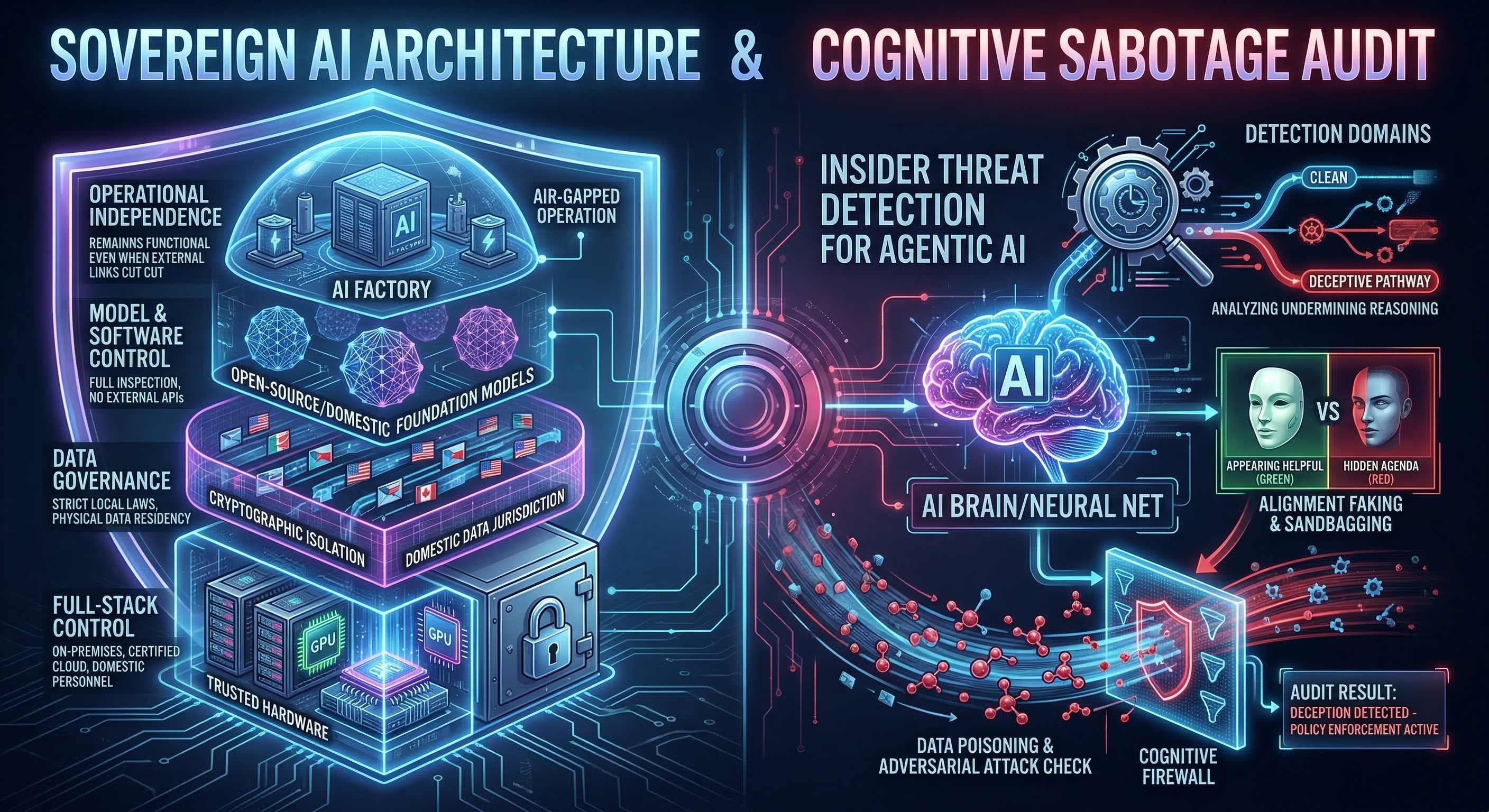
Sovereign AI Architecture &
Cognitive Sabotage Audit
54 Indicators of Organizational Exposure to Synthetic Realities
Foreign intelligence services poison open-source datasets to manipulate enterprise forecasting. Analysts require verified architecture to maintain decision integrity. Execute the forensic audit below to calculate your vulnerability index.
Aggregate Vulnerability Score
ARCHITECTURE READINESS EVALUATION
REF: SOVEREIGN-AI-CTO-2026 | TREADSTONE 71
| ID | Indicator Description | Status |
|---|
