Pillar 01 // The T71 Standard
The Adversary Index. How the Score Is Built.
This is the methodology page for Pillar 1 of The T71 Standard. It covers the eight sub-indices, the composite, the six posturing bands, the four editions, the editorial calendar, and the independence rules. The Index itself, with the free Tier 0 download, lives at treadstone71.com/tai.
Inaugural release July 15, 2026. Q3 refresh released October 5, 2026, with the inaugural Cognitive Warfare Tradecraft Reference (CWTR). Next release Q1 2027.
Bottom Line
What the Index is, in one screen.
The Adversary Index converts 24 years of Treadstone 71 doctrine into one quarterly metric per adversary. STEMPLES Plus supplies the environment analysis, the Cyber Intelligence Capability Maturity Model the program context, and the 66 Advanced Structured Analytic Techniques the analytic discipline. Boards and agencies use the composite to prioritize threats and justify budget. Analysts use the eight sub-indices to direct collection.
Inaugural release: July 15, 2026. Q3 refresh: October 5, 2026. Next release: Q1 2027.
- Who
- Treadstone 71 LLC, a pure-play intelligence consultancy founded in 2002.
- What
- The Adversary Index, a quarterly 0 to 100 composite score per adversary, published as Pillar 1 of The T71 Standard.
- Impact
- Anecdotal threat reporting replaced by a comparable, dated, evidence-graded number.
- Why now
- State actors run production AI-enabled narrative operations. The pace of cognitive attack now exceeds the pace of case-study reporting.
- Result
- Budget requests tied to scored adversary capability rather than vendor alerts.
- Outlook
- Quarterly releases on a published calendar. Subscriber feedback enters methodology revisions through the Editorial Board.
The Index in Numbers
Scoring Method
Eight sub-indices, one composite
Analysts score each of eight sub-indices from 0 to 100 per adversary against a published rubric, then average the eight to set the composite. The score reflects executed operations, not stated intent. A higher composite marks greater operational maturity and a sharper defensive requirement.
The scoring framework ships in every edition, Tier 0 included. Tier 1 and above adds the indicator inventories and rubric calibrations behind each sub-index.
// Hover or tap any vector to inspect its scoring definitionCognitive Warfare Velocity:
speed of narrative production and deployment, from triggering event to first coordinated output
OPSEC Sophistication:
discipline of the adversary's own security: infrastructure hygiene, persona management, and resistance to exposure
Adaptation / Evolution Index:
rate of adaptation under pressure; how fast the actor re-tools and recovers after disruption
Narrative Volume:
propaganda saturation across channels, synthetic media included, measured by sector
Sectoral Targeting Concentration:
concentration of targeting by industry and region; where the actor's effort actually lands
AI Tradecraft Adoption:
depth of AI adoption in the actor's tradecraft, from experimental use to production
Doctrinal Maturity:
maturity of the long-term planning and doctrine behind the actor's campaigns
Operational Tempo:
frequency and cadence of operations, and the escalation pattern they follow
Reading the Score
Six posturing bands, one rubric
Scores translate into estimative language under Intelligence Community Directive 203 and Sherman Kent conventions. Each numerical band maps to a defensive response.
| Score | Posturing Band | Defensive Response |
|---|---|---|
| 80 to 100 | Apex | Expect coordinated operations across multiple sectors. Sustain maximum defensive posture. |
| 65 to 79 | Mature | Expect focused operations against your industry. Structured intrusions likely. |
| 55 to 64 | Operational | Prepare for targeted operations. Early detection holds a roughly even chance. |
| 45 to 54 | Developing | Monitor for isolated activity. Sustained campaigns unlikely. |
| 35 to 44 | Nascent | Track emerging tactics. Resources for immediate harm highly unlikely. |
| 0 to 34 | Negligible | Maintain baseline security. Operations stand almost no chance of execution. |
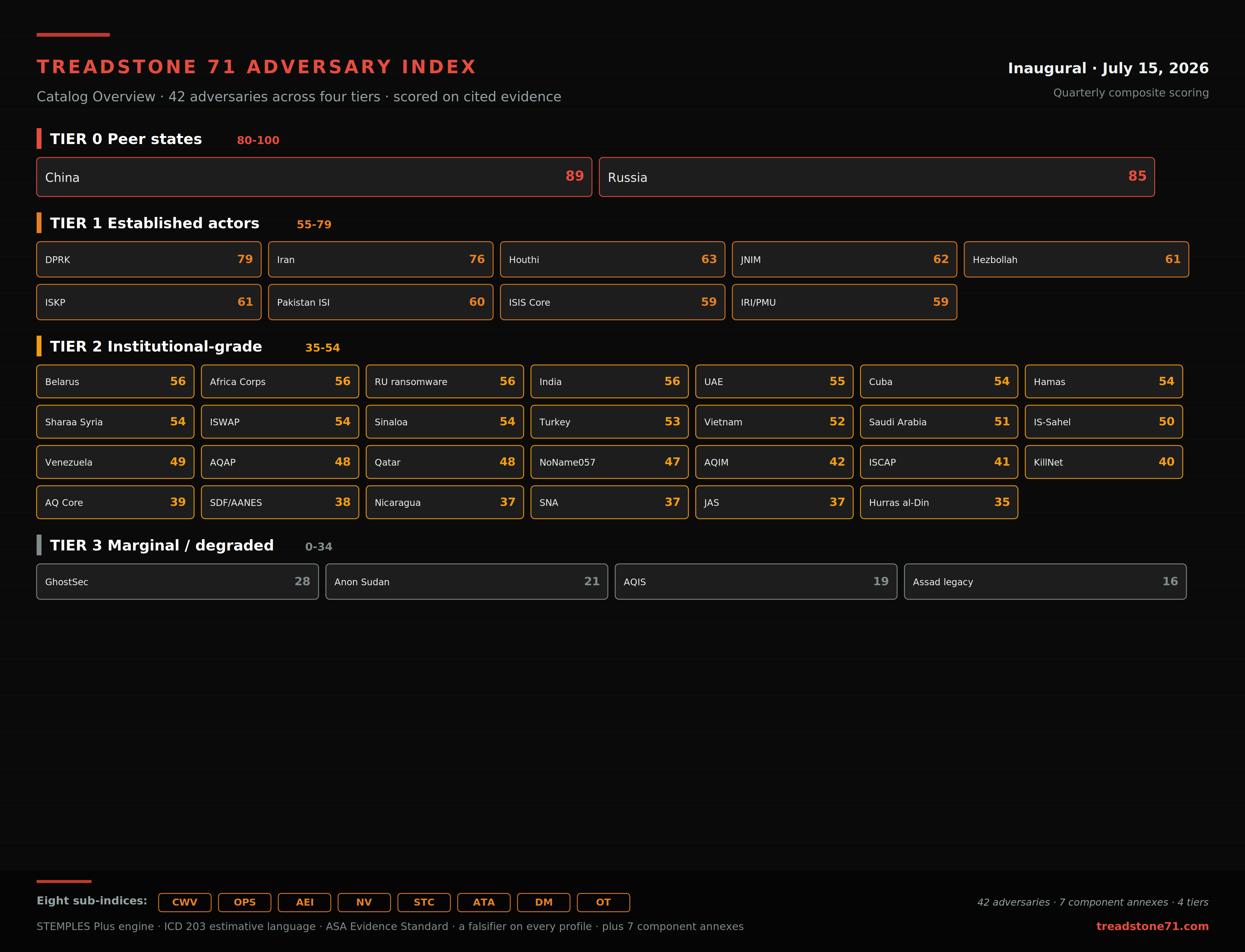
Bands and tiers are separate scales. Bands translate a score into a defensive response. Tiers organize the published editions: Tier 0 carries the Big Four, Tier 1 the next seven actors, Tier 2 the next 27, and Tier 3 the four floor actors and seven component annexes. A band describes threat severity. A tier describes what a subscriber receives.
What the Score Is For
Measurement over anecdote
Qualitative threat reports do not compare. A scored adversary does. The Index gives directors one rubric to compare actors quarter to quarter, and gives analysts the vectors to act on.
Three uses recur across subscribers:
- Board reporting. Audit committees get an objective, dated measure and the evidence grade behind it.
- Procurement. Security teams match platform purchases to documented adversary capability instead of vendor claims.
- Allied coordination. Agencies and partners share one published metric and skip the methodology argument.
Why Now
Three conditions behind the Index
The Index exists because three conditions held at once in 2026. One is an assessment of the adversary. Two are facts about the market.
State actors run AI-enabled cognitive operations at production scale
Russian, Chinese, Iranian, and DPRK formations deploy LLM-enabled narrative production as routine. Automated deepfakes and agent-orchestrated influence networks now operate at machine speed, faster than case-study reporting can follow.
Estimative assessment: almost certain (95 to 99 percent) that production-grade AI-enabled cognitive operations run across the four primary state actors as of the Q3 2026 release.No one else publishes the recurring number
Vendor reporting stays fragmented and episodic. No vendor, government office, or academic institution publishes a recurring, methodologically transparent composite score per adversary. The Index fills that slot.
Status: as of the July 15, 2026 release, Treadstone 71 found no comparable published index. Corrections and comparisons are welcome atDirectors ask for a comparable number
Audit committees at defense primes, financial institutions, and corporate boards ask how one adversary compares to another, quarter to quarter. Anecdote does not answer that question. A scored, sourced, dated number does.
What the Index supplies: one 0 to 100 composite per adversary, the quarter-over-quarter delta, and the evidence grade behind each score.Coverage
Four classes of adversary
Coverage expands as evidence meets the scoring threshold. Named units appear in the catalog from the July 15, 2026 release onward.
// Hover or tap any class card to inspect catalog parametersState Actors
the four primary nation-state adversaries, scored at full depth with strategic, operational, tactical, and technical tearlines
Public pages: China, Russia, North Korea, and Iran
Proxy Networks
state-aligned and state-sponsored formations operating at arm's length, mapped across geographies
Criminal Syndicates
ransomware, hacktivist, and transnational criminal organizations that run influence operations alongside intrusion
Emerging Actors
groups approaching operational maturity, tracked until evidence meets the scoring threshold
Inside the Tier 0 Edition
One download. Free. No registration.
The Tier 0 edition is a single PDF, downloaded directly from the Index page with no form in between. It sets the board's baseline and shows the shape of the whole field.
- The Big Four at four tearline depths: strategic, operational, tactical, and technical reads for China, Russia, DPRK, and Iran.
- The complete 42-actor field at catalog level: every scored adversary, placed.
- The scoring framework: the eight sub-indices, the composite method, and the six posturing bands.
- A board-level insight layer: what the ranking hides, written for directors.
- Methodology and version footers: the release iteration and the rules it was scored under.
Editions and Pricing
Choose the edition your desk needs
The public edition sets the baseline. Each paid tier includes everything below it and adds a distinct layer of capability for an analyst desk, an institution, or an executive desk.
The Big Four at full four-tearline depth, the complete 42-actor field at catalog level, the scoring framework, and a board-level insight layer that shows what the ranking hides.
Download Free Edition →Everything in Tier 0, plus the seven actors below the Big Four at full eight-sub-index depth (eleven scored in all) and the analyst operating layer: collection and hunt priorities, an indicator-of-change tripwire register, quarter-over-quarter movers, a responsibility matrix, and a resourcing and readiness read.
Everything in Tier 1, plus all 27 Tier 2 actors at STEMPLES Plus depth (38 scored in all) and the institutional portfolio layer: cluster signatures, a sector-and-region exposure map, portfolio prioritization, and control-framework mapping to NIST and CIS. The companion scoring workbooks are included.
Everything in Tier 2, plus the four floor actors and the seven component annexes (the complete field) and the decision-advantage layer: a composite weighted to your organization, commissioned offensive active-probe operations under MNDA, degradation-pathway tracking, and scenario and wargame facilitation, delivered by a named senior analyst with quarterly board briefings.
Multi-year and sector pricing. Multi-year prepayment reduces Tier 1 and Tier 2 cost by 10 percent. Government, defense prime contractors, and academic institutions reduce cost by 15 percent. State the arrangement you need when you inquire.
Commitments
What every edition commits to
Three commitments hold across every release. Each one carries a check the reader can run without asking us.
One comparable number per adversary, per quarter
Every scored actor carries a 0 to 100 composite, the eight sub-index scores, the quarter-over-quarter delta, and the evidence grade under the ASA Evidence Standard.
Check it: open any profile in the edition. The composite, the delta, and the grade sit on the first page.
Procurement mapped to scored capability
Tier 2 and Tier 3 editions map each scored adversary's capability to control frameworks (NIST and CIS), so a platform purchase ties to a documented threat rather than a vendor claim.
Check it: the control-framework mapping ships in the Tier 2 companion scoring workbooks.
Methodology revised on a published schedule
Subscriber feedback reaches the Editorial Board and enters the next methodology revision. The rubric never changes mid-cycle, so a delta always means the adversary moved, not the ruler.
Check it: the version footer on each edition and the change record in the methodology white paper.
Field Coverage
How far each edition reaches into the field
The bars show the share of the 42-actor catalog scored at depth in each edition. Every edition includes the tiers beneath it.
Tier 0 · Public
4 of 42 actorsThe Big Four at four tearline depths, with all 42 actors at catalog level. Enough to set the board's baseline and read the shape of the field.
Tier 1 · Analyst
11 of 42 actorsAdds the seven actors below the Big Four at full sub-index depth, plus the analyst operating layer for a working desk.
Tier 2 · Institutional
38 of 42 actorsAdds all 27 Tier 2 actors at STEMPLES Plus depth, the sector-and-region exposure map, and the control-framework mapping to NIST and CIS.
Tier 3 · Executive Desk
42 of 42, plus 7 annexesCompletes the field with the four floor actors and the seven component annexes, weighted to your organization and briefed to the board each quarter.
Probability language. Assessments in every edition use seven terms tied to numeric bands: almost certain (95 to 99), highly likely (85 to <95), likely (55 to <85), roughly even chance (45 to <55), unlikely (15 to <45), highly unlikely (5 to <15), almost no chance (1 to <5). Verified facts and adversary claims never share a sentence.
Independence
Scoring stays separate from consulting
Treadstone 71 separates scoring from consulting. Every quarterly release completes a four-stage validation cycle: collection, dual-analyst arbitration, Editorial Board challenge, and embargo review.
No outside party reviews the scoring before release.
Analysts never alter a score for commercial reasons. Teams assigned to the Index avoid direct consulting with implicated organizations. Conflict-of-interest disclosures publish each quarter.
The ASA Evidence Standard methodology white paper published September 15, 2026. Every TAI score carries its source and evidence grade under that standard.
Release Calendar
A 90-day cycle, published in advance
The Index runs on a 90-day editorial calendar so internal briefings can be set against it. The Q3 refresh released October 5, 2026, with the inaugural Cognitive Warfare Tradecraft Reference (CWTR). The next public release lands in Q1 2027.
- Days 1 to 15: Analysts lock scoring against the rubric.
- Days 16 to 30: The Editorial Board challenges every quarterly delta above five points.
- Days 31 to 45: Teams assemble the public artifact and brief external counsel.
- Days 46 to 60: Subscribers receive embargoed pre-release data.
- Day 61: The public release posts at 0900 Eastern.
- Days 62 to 90: Analysts monitor errata and calibrate the next quarter.
Common Questions
What buyers ask about the methodology
What does The Adversary Index give my organization?
A scored, sourced, dated number per adversary, updated each quarter. Boards use the composite to prioritize threats and justify budget. Analysts use the eight sub-indices to direct collection and hunt priorities.
What do the eight sub-indices measure?
Cognitive Warfare Velocity, OPSEC Sophistication, the Adaptation/Evolution Index, Narrative Volume, Sectoral Targeting Concentration, AI Tradecraft Adoption, Doctrinal Maturity, and Operational Tempo. Each isolates one measurable trait, so a change in the composite traces back to the vector that moved.
When does the Index release?
The inaugural edition released July 15, 2026, and the Q3 refresh released October 5, 2026, with the inaugural Cognitive Warfare Tradecraft Reference. The next release lands in Q1 2027. Releases follow a quarterly cycle on a published 90-day editorial calendar. Subscribers receive embargoed pre-release data ahead of each public drop.
Which edition fits which desk?
Tier 0 is free and sets the baseline. Tier 1, at $25,000 a year, equips a working analyst desk. Tier 2, at $75,000 a year, covers an institution's portfolio and maps controls to NIST and CIS. Tier 3, at $250,000 a year, runs an executive desk with a composite weighted to your organization and quarterly board briefings.
Which adversaries does Treadstone 71 score?
42 adversaries plus seven component annexes: Class A state actors, Class B proxy networks, Class C criminal syndicates, and a Watch List of groups approaching operational maturity. Named units appear in the catalog from the July 15, 2026 release onward. Each Class A state actor has its own public page: China, Russia, North Korea, and Iran.
How does TAI connect to the other Treadstone 71 frameworks?
The Index draws on STEMPLES Plus for environment analysis, the Cyber Intelligence Capability Maturity Model for program context, and the 66 Advanced Structured Analytic Techniques for the analytic discipline. Tier 2 maps scored capability to NIST and CIS control frameworks.
How is scoring kept independent?
Scoring and consulting stay separate. Every release passes a four-stage validation cycle: collection, dual-analyst arbitration, Editorial Board challenge, and embargo review. No outside party reviews the numbers before release. Conflict-of-interest disclosures publish each quarter.
Get the Index
Start with the free edition
Download the Tier 0 report today. Subscribe to Tier 1, 2, or 3 for the working layers. Journalists and researchers request press access through the contact form.
Download Free Edition → Request a Subscription Request Press Access
